Friday 20th AprilPETER ROBERTS:
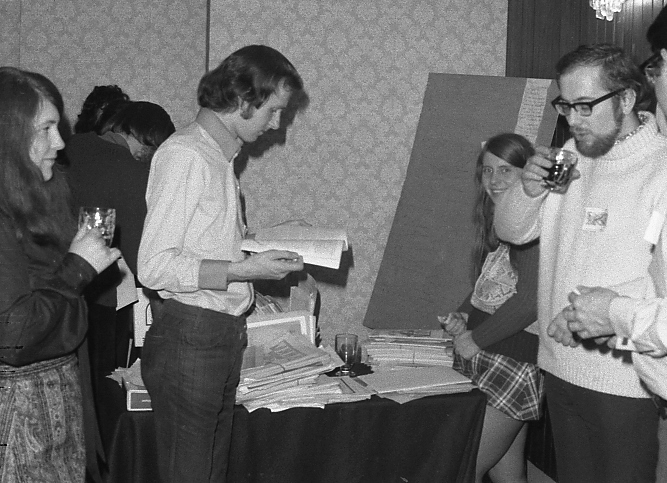
On Friday Gray (who'd stayed overnight) and I managed to get up early and reached the hotel just before the convention programme was about to begin; more importantly, we reached there as the hotel bar opened - a temporary affair, but well-stocked in everything except cigarettes. We met numerous fans, including most of the foreigners who'd made it to the con; there weren't as many as usual, possibly due to the smallpox scare which made entry into Britain impossible without a vaccination. But I did meet Tom Schlück and his future wife, virtually the only Germans present (except Holger Muller who is now living in the UK), Simon Joukes, one of the organizers of the forthcoming Beneluxcon this May in Ghent, and Michel Feron, together making up part of the Belgian contingent; there were several Dutch fans present and one or two from Sweden, including Nils Andersson who is presently living in Britain. Banks Mebane and Danny Plachta were two of the American fans present - others included faned Matthew Schnook, the OMPAcon's US Agent, Sam Long, and several from the US forces in Europe (Al de Bettencourt, and so on).
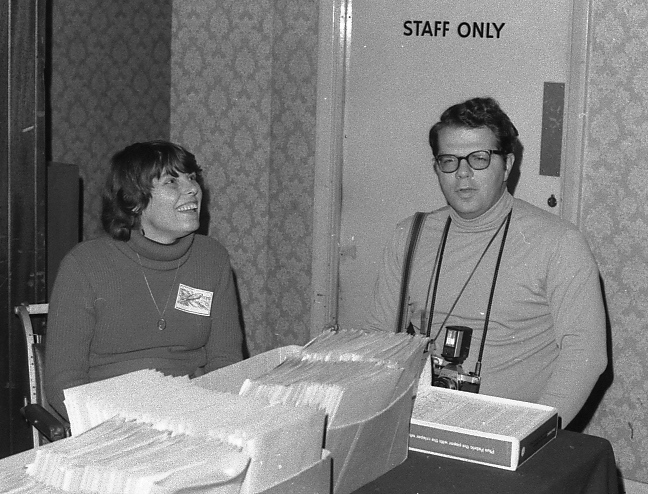
As the only active fan in Bristol, I had to undergo an interview on Friday ("Do you read Superman comics?" &c) and even had a couple of photos taken - an unlikely pose of Jack Cohen and myself discussing a Silverberg novel that neither of us had read. I never found out the name of the paper or whether anything ever appeared - information welcomed! I also turned down an interview with Radio Bristol, being nervous of such things, and I think they asked John Brunner to speak as their second choice. I was a little swollen-headed on Friday...
MALCOLM EDWARDS: If OMPAcon had a major fault it was in the way it began on Friday. The programme began too early, presumably in response to the increasing number of people who arrive on the Thursday evening. I think this was a bad misjudgment, and I hope future conventions should learn from it (are you listening, Ian?). I would think a 3pm opening would be quite early enough (perhaps 4pm when, as will happen next year, many attendees will be faced with very long journeys). We arrived at lunchtime, having come down on a train which didn't involve getting up too early and rushing; although we were there at what I expected to be the start, everything was apparently under way already. Another mistake was in not having any proper opening item. The programme drifted from some films straight into the opening panel. The net result of all this was a feeling of dislocation which persisted through much of the next day. VERA JOHNSON: In the afternoon, more films -- good cartoons and first showing of Star Trek "bloopers", later repeated many times. Then a panel -- John Brunner, Chip Delany and Mark Adlard discussed non-SF influences on their writing.
Delany said he never read any SF until his wife (a reader with a publishing firm) lamented the dearth of good MSS in the field and suggested he try his hand at it.
MALCOLM EDWARDS: The first vaguely familiar face I encountered was Newcastle fan Thom Penman, who seemed to have grown up since I last saw him two years previously - but this initial impression soon proved wrong. Thom, who had surely set some kind of record by issuing a long report on the 1972 Eastercon in the week before this one, had brought his water-pistol with him in order to give himself something to write about next year. Worse, he was not alone, having been accompanied by the well-known, sensitive, pre-adolescent poet Ritchie Smith. Anyway, I'm not going to go into that side of the convention very much, although it provided intermittent entertainment (i.e. when it was aimed at someone other than me); in any case, I preferred Penman's (I think it was his) other strange device - a small pink object which did a marvellous cackling impersonation of John Piggott, right down to the battery you had to insert before it worked. No, I'll devote most of this to the more formal, or at least normal aspects of the weekend, because I wouldn't want to give any of you who may never have visited a convention the impression that it's somewhere where silly things happen. Gosh, no.
PETER ROBERTS: As usual, I saw little of the official programme. On Friday afternoon Dave Kyle chaired a panel, "Fandom At Random", investigating the effect fandom had had on various people's lives - June Moffatt, Ethel Lindsay, Tom Schlück, Terry Jeeves, and Keith Freeman listed certain notable personal and professional influences that fandom had had on them. Turning to the audience, Dave asked how many people had travelled more than fifty miles to the con (demonstrating one effect of fandom); a mass of hands rose. He then asked how many people had merely come from Bristol... I was alone in that peculiarity. He concluded the panel with a cunning question to the audience: "How many of you consider yourselves members of fandom?" This sounded very sercon and no one responded, so Dave reversed it: "How many of you don't consider yourself members of fandom?" This caused as much consternation and again no one responded. A nice point was thus made - I'm still not sure what, but it definitely made a point!
JUNE MOFFATT: I started out by saying that I had no idea what my life would have been like without fandom. I've been in fandom more or less for twenty-five years, and trying to analyse a time-track that branched that long ago was a hopeless task, as far as I was concerned. I hope I made it plain that I like fandom, and quoted Tony Boucher's opinion that "All knowledge is contained in fandom", which drew a surprised-sounding laugh from the audience. I think maybe most of them hadn't heard that before. Some of the other people on the panel were closer to their pre-fannish days, and Tom Schlück was over into his Dirty Old Pro days. Dave Kyle finished up the discussion by agreeing with me, that it was impossible to tell what his life would have been like without fandom. A whole lot less interesting, almost for sure.
VERA JOHNSON: Another panel, fans describing how SF changed their lives. Then Ken Bulmer chaired a third panel of new writers which I had looked forward to, but found disappointing. They didn't seem to know what they should talk about.
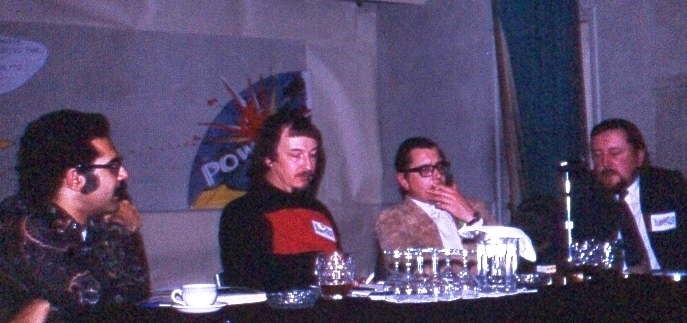
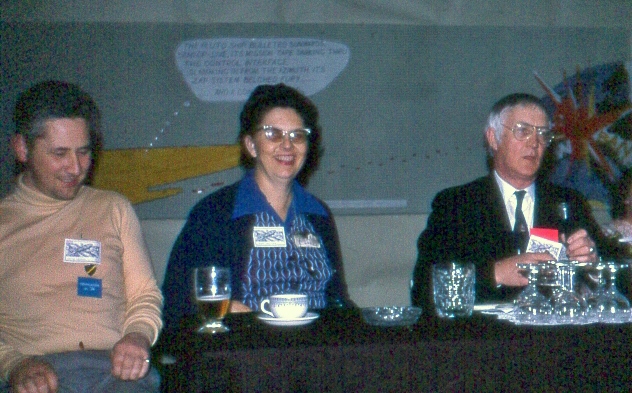
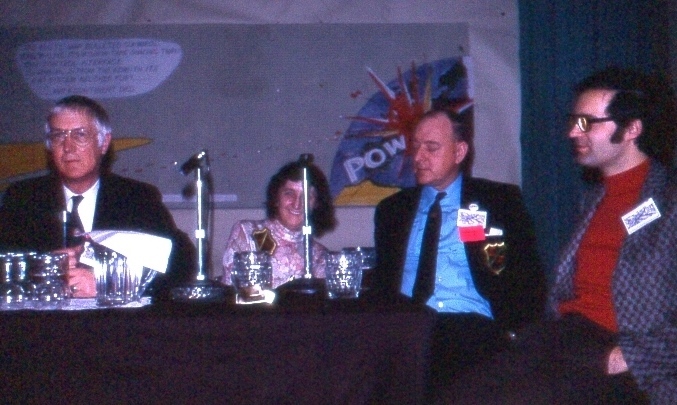
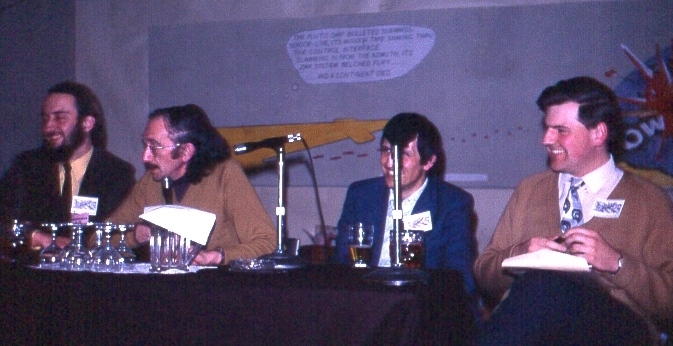
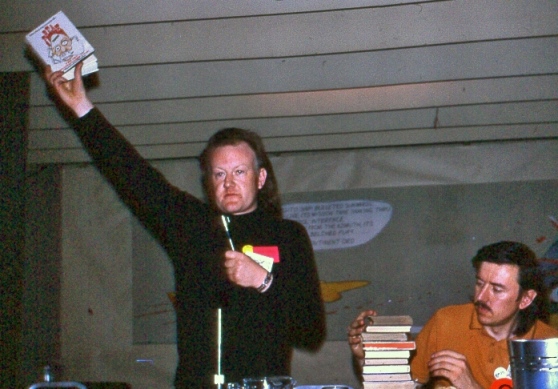
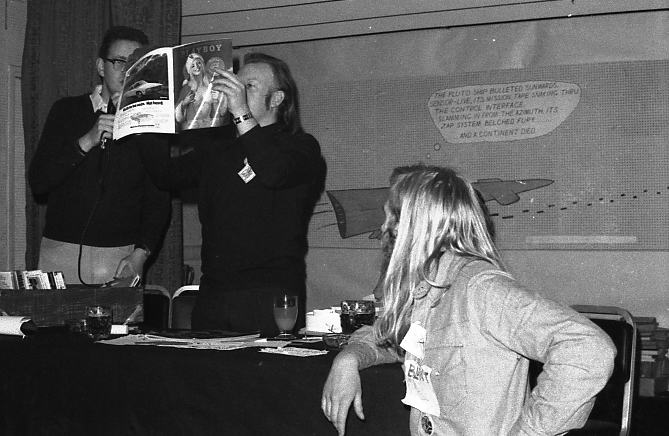
The backdrop seen in these photos was obviously parodying Roy Lichtenstein's 'WHAAM!', which ripped off comicbook artist Irv Novick. The word balloon reads: LEN MOFFATT: At 8 p.m. the evening session was opened, with Ted Tubb and Ken Bulmer introducing the various famous or well-known fans and pros present. The auction (scheduled for 9 o'clock) started at 8:45. Roger Peyton and I took turns auctioning a variety of books, hardcover and paperback. I was glad that the British had converted their money to the decimal system, so that all the bids were easy for me to understand. For instance, if someone bid 20 or 25 pence, (usually given as 20p or 25p) I had no trouble following that. Had their bids been in shillings, etc., I might have had a problem. On the rare occasion when the bidding got up to a pound or more there was still no problem. It occurred to me later that they might have been bidding in this manner to make it easy for the American auctioneer, but I'm not sure but what it was simply the now-popular use of the decimal system - or at least the acceptance of it, whether they liked it or not.
JUNE MOFFATT: The decimal system is well established, all right, but the old terminology is still used. We heard several references to a "bob", which is now worth five new pence, even though there isn't officially a coin known as a shilling. Tenpence and two-shilling coins circulate equally. However, I don't think anyone did use the old terminology in bidding at the auctions. LEN MOFFATT: While auctioning, I couldn't help using a part of what I have that passes for a brain to convert the bids into American money, and was often shocked at how little things were going for. At that time, the pound was going for about $2.50 U.S., so when somebody bid 10p it was like bidding 25¢ American. The fact is that the average British fan isn't as well off as the average American fan, so that books and mags that sold for so little over there would have brought a bit more (in some cases quite a bit more) at a similar-sized auction in the States. At a later auction, I bought a stack of Fred Brown paperbacks. Don't remember what I paid for them, but I know I would have paid a good deal more, Stateside.
PETER ROBERTS: TAFF winner Len Moffatt started the first of an endless series of auctions that evening, together with Rog Peyton. The Bristol and District Sf Group Library was one of the items auctioned off at the OMPAcon. It had been rotting away in my garage ever since the BaD Group disbanded in 1968 and the Mercers, who'd previously housed it, moved to Helston. Sold in lots, the BaD Group Library (mostly paperbacks and magazines) raised £45 and the money was split four ways between TAFF, DUFF, the BSFA Library and the OMPAcon. A special fanzine auction was held later, Gray Boak auctioneer, but no notable items were sold - except for several thousand issues of HELL...
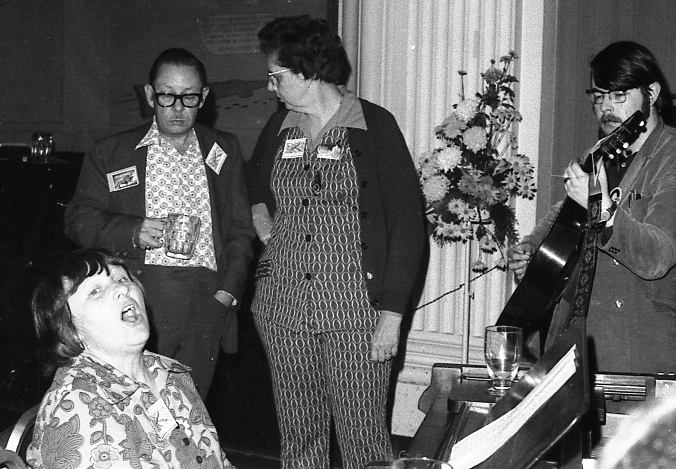
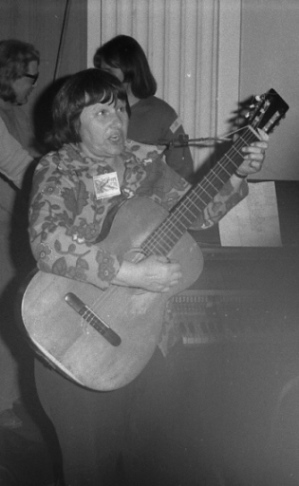
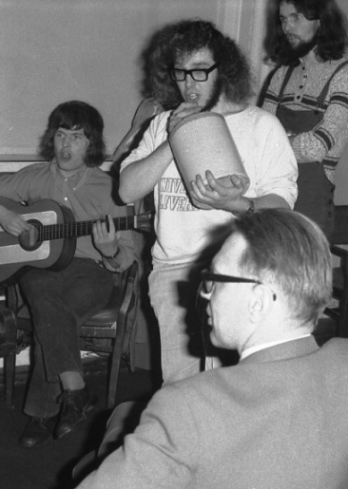
VERA JOHNSON: At night, "Look Who's Here", where celebrities were supposed to be introduced. Most of them not visible -- in the next room, propping up the bar. Then the first of many auctions. I bought more than I could afford, which got to be a habit. A music session around the piano, followed by folk singing in the bar until 2a.m. (And drinking, it goes without saying.) LEN MOFFATT: I asked someone if Mike Rosenblum would be at the con. Mike and I corresponded back in the '40s, and he was one of the many British fans I wanted to meet. I was told that his son Howard was there, and that Mike would be along later. True enough. We met Howard, who would be described by American mundanes or squares (and no doubt by British likewise) as a "hippie", in that he dressed most casually and had a whole lot of bushy hair. We introduced ourselves to Howard, who assured us that his dad would be there. Later that night, or Foo knows it might have been the next day, we met Mike and had a good talk with him and George Locke in the huckster room. Mike is no longer the slim young man in the photo he'd sent me nearly thirty years ago - but then I am no longer the 129-pound youngster I used to was. (That's 9 stone 3, for our British friends.) That same night we also met (June for the first time, me for the second time) Jim O'Meara, a Chicago fan who now works in Dublin. I hadn't seen Jim since 1958. Later in the evening we had a good long talk on old times in fandom and what was happening now, etc.
After the auction, the meeting room was left open and the piano in the corner was put to good use by a lady named Vera Johnson, who was accompanied by a chap named Russ on guitar and Howard Rosenblum on jug. June and I went over to join the group, as they were playing and singing songs from the twenties and thirties. We even danced a little. I noticed that other, younger, fans were joining in the singing and seemed to know all the words to these old tunes. I remarked on this to Mike Rosenblum and Ken Cheslin, and was advised that the British youth considered these old tunes to be folk songs. So there we were in the midst of a folk-singing session - British style.
We looked in at one or two of the room parties, and June went to bed about 1 a.m. But ol' diehard Jim had to stay up until the wee small hours because this was one helluva fine convention. I returned to the meeting room and found that the folk singers had abandoned the piano and adjourned to a corner of the bar. Vera was now playing guitar along with Russ, and Howard was still blowing jug like he had six sets of lungs. I joined James White and Les Flood who were standing at the bar and gave them a hand in holding it up. Once again I couldn't help observing (to myself, I didn't mention it to Jim as I'm sure he's heard it enough) how much Jim White resembles Van Vogt or vice versa. The folk-singing continued. The night, or rather, the late morning continued blissfully. People left, more people came in, but finally we were down to the hardcore stay-up-lates. Now I was talking with Jim O'Meara, and watching the antics of the young singers. Looking at my watch, I saw that it was well after 3 a.m. It had to be past official closing time, but then this was a private bar (or a public bar turned into a private bar for the convention). Eventually, a young manager-type entered and asked that people leave, as they really did have to close up. He was quite polite about it, and seemed to regret having to perform this duty. The kids began to protest. They didn't do anything violent, but someone did shout "Throw the bod in the river!" Other than that, they merely complained loudly and bitterly that the bar should be left open as long as there were x number of persons present. I gathered that a minimum number had been agreed on between the hotel and the committee. They sent someone out to bring in more bodies. They continued to sing. It was one of the most amiable protests I ever saw or heard of. I stood there with Jim, laughing, digging it, loving it. But all good things must end, and I knew I should get some sleep before it was time to start another convention day. Jim and I talked a while longer out in the meeting hall. I was bringing him up to date on people we both know. It was after 4 a.m. when I finally hit the sack.
|
|